

Choose the right tank size
Skip the bowls. While small glass containers are popular for bettas, they offer none of the stability your fish needs to survive long-term. A betta in a bowl is like a person living in a closet; the water quality degrades rapidly, and temperature fluctuations become deadly. To give your betta a proper home, you need a tank that holds enough water to dilute waste and maintain a consistent environment.
The minimum standard for a single betta is a 5-gallon tank. This volume provides the necessary surface area for gas exchange and the thermal mass to keep the water temperature steady. Smaller tanks, such as those under 3 gallons, require frequent, stressful water changes to prevent ammonia spikes that can poison your fish. A 5-gallon setup allows for a more forgiving routine and significantly reduces the risk of disease.
A larger tank is not just a luxury; it is a health requirement. The extra water volume buffers against rapid changes in pH and temperature, creating a stable ecosystem where your betta can thrive. Start with this minimum size to ensure your fish has the best chance at a long, healthy life.
Install heater and filter correctly
Proper setup of your heating and filtration systems is the foundation of betta fish care. Bettas are tropical fish that require stable, warm water to thrive. A sudden drop in temperature or a water current that is too strong can cause stress, weaken their immune system, and lead to illness. The goal is to create a calm, consistent environment that mimics their natural habitat.
Start by installing the heater. Bettas are most comfortable in water between 78°F and 80°F (25.5°C–26.5°C) [[src-serp-2]]. Choose a submersible aquarium heater with an adjustable thermostat and a protective guard to prevent burns. Place the heater vertically near a corner or behind decor to ensure good water flow across the heating element. Submerge it fully according to the manufacturer’s minimum level markings. Allow the heater to run for 24 hours with a reliable aquarium thermometer before adding your fish to confirm the temperature remains steady within the target range [[src-serp-1]].
Next, install the filter. Bettas have long, delicate fins that can be torn by strong suction or powerful currents. Avoid powerful canister or hang-on-back filters designed for active swimmers. Instead, use a sponge filter or a small internal filter with a flow restrictor. A sponge filter provides gentle mechanical and biological filtration while producing soft bubbles that add surface agitation without creating a current. If using an internal filter, adjust the output flow so it is barely visible, or point it toward the glass to break the current. This ensures water quality remains high without exhausting your betta [[src-serp-6]].
Select a submersible heater with an adjustable thermostat, typically 25–50 watts for a 5-gallon tank. Ensure it has a protective guard to prevent contact with the glass or your fish. Avoid unheated tanks, as bettas are tropical and will become lethargic or sick in cool water.
Mount the heater vertically in a corner or behind a plant. Fully submerge it to the marked water line. Secure it with suction cups so it does not float or tilt, which can cause overheating or breakage. Leave it running for 24 hours to stabilize the temperature before adding fish.
Choose a sponge filter or a small internal filter with a flow adjuster. Sponge filters are ideal because they provide gentle water movement and biological filtration without creating a strong current that can damage your betta’s fins. Avoid powerful filters designed for active, fast-swimming fish.
Set the filter output to the lowest setting. If the current is too strong, point the output toward the glass or use a spray bar to diffuse the flow. Place a thermometer near the heater and filter to verify that the water temperature remains between 78°F and 80°F. Your betta should swim calmly, not struggle against the current.
Cycle the tank before adding fish
Skipping the nitrogen cycle is the most common reason betta fish die in new tanks. When you set up a new aquarium, it contains no beneficial bacteria to process waste. If you add a betta immediately, its waste accumulates as ammonia, a toxic compound that burns gills and causes stress. This process, known as "new tank syndrome," can kill a fish within days.
Think of the nitrogen cycle as building a biological filter. You are cultivating microscopic colonies of bacteria that convert toxic ammonia into nitrite, and then into less harmful nitrate. Without this established colony, your tank is essentially a sterile bowl of water that becomes poisonous as soon as it is occupied.
The cycle takes time, usually two to six weeks, depending on temperature and tank size. You can speed up the process by adding a source of ammonia, such as fish food or pure ammonia drops, to feed the bacteria. Alternatively, you can use a bottled bacterial starter to introduce existing colonies. The goal is to reach a point where the water can handle biological load before the fish arrives.
Important: Never add a betta to a new tank until ammonia and nitrite levels read zero.
To verify the cycle is complete, use a liquid test kit rather than relying on strip tests, which are often inaccurate. Test the water every two to three days. The cycle is finished when you can add a small amount of ammonia and see it drop to zero within 24 hours, indicating a robust bacterial colony is present.
Once your tests confirm zero ammonia and zero nitrite, your tank is biologically ready. You can then introduce your betta fish with confidence, knowing the water chemistry is stable and safe for its health.
Add plants and hiding spots
Your betta needs cover to feel secure. In the wild, these fish hide among dense vegetation to escape predators and rest. A bare tank leaves them exposed, which increases stress and can shorten their lifespan. Adding plants and hiding spots recreates that natural refuge, giving your betta a place to retreat when it feels threatened or simply wants to sleep.
Live plants are the best choice for a betta tank. They provide genuine cover, help filter water by absorbing nitrates, and create a more stable biological environment. Anubias and Java Fern are ideal because they are hardy and can be attached to driftwood or rocks rather than planted in substrate. If live plants aren't an option, silk plants are a safe alternative. Avoid plastic plants with sharp leaves, as bettas have long, flowing fins that can easily tear on rough edges.
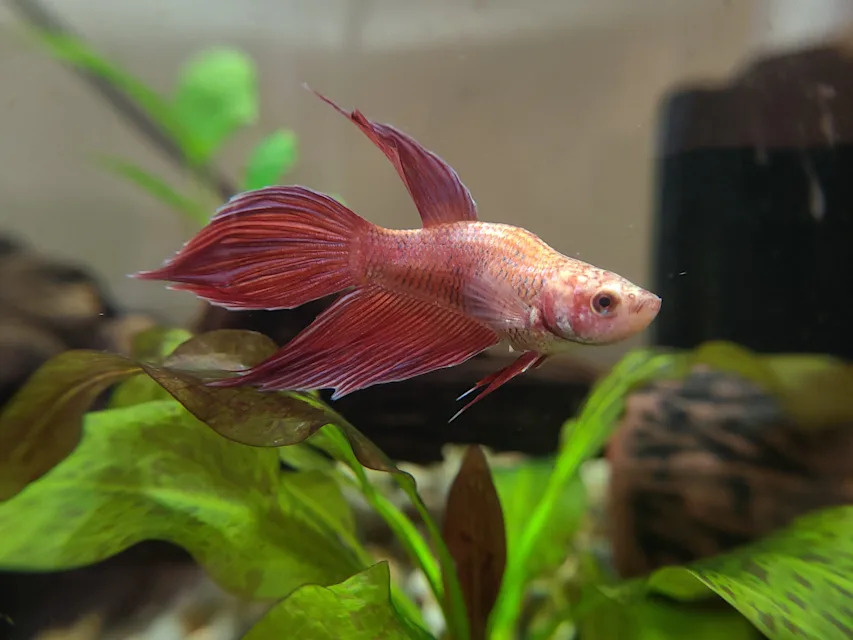
In addition to greenery, add physical structures for exploration. Driftwood, ceramic caves, and half-log ornaments break up sightlines and create territories. Bettas are labyrinth fish that often rest near the surface, so ensure there are plants with leaves that reach the water's surface. This allows them to gulp air while remaining partially hidden. The image below shows a well-planted tank where the betta can navigate through the foliage comfortably.
Feed and maintain water weekly
A consistent routine is the best defense against disease. Bettas live in small volumes of water, so waste accumulates quickly. Feeding correctly and changing water on schedule keeps ammonia low and stress minimal. Follow this sequence every week to keep your tank stable.
Remove tap water from the tank at least 24 hours before the change, or treat it immediately with a water conditioner. Bettas are tropical fish that thrive in warm water, so the new water must match the tank temperature (76–81°F) to prevent shock. Use a thermometer to confirm it stays in range before adding it back.
Use a gravel vacuum to remove 25–30% of the tank water. Gently stir the substrate to pull out uneaten food and waste. Avoid cleaning the filter at this stage unless it is clogged; beneficial bacteria live in the filter media and need time to re-establish.
Offer 2–4 pellets of high-quality betta food once or twice daily. Only give what the fish can eat in two minutes. Overfeeding is the leading cause of poor water quality and bloating. Remove any floating food immediately with a net.
Slowly add the conditioned, temperature-matched water back into the tank. Watch your betta for a few minutes to ensure it is swimming actively and showing no signs of stress or disease.
A clean tank makes a happy fish. Stick to this weekly schedule, and your betta will live a longer, healthier life.
Watch for signs of stress or illness
A healthy betta is active, curious, and displays vibrant, flowing fins. When something is wrong, they often show subtle physical changes before they stop eating or hide in corners. Catching issues early is the difference between a quick fix and a lost pet.
Common Health Issues
Ich (White Spot Disease) appears as tiny salt-like grains on the body and fins. It is caused by parasites and thrives in fluctuating water temperatures. If you see these spots, slightly raise the water temperature to 80°F (27°C) to speed up the parasite life cycle while adding aquarium salt or a designated medication as directed.
Fin Rot starts with ragged or frayed fin edges that may look white or translucent. This is often a bacterial infection triggered by poor water quality. Immediate action involves a 25-50% water change to remove toxins and adding a broad-spectrum antibacterial treatment to the tank.
Swim Bladder Disease causes the fish to float upside down, sink to the bottom, or struggle to maintain buoyancy. This is rarely a primary disease but a symptom of constipation, overfeeding, or internal infection. Try fasting the betta for 24-48 hours, then feed a small amount of cooked, shelled peas to clear the digestive tract.
Stress Indicators
Stress weakens a betta’s immune system, making them susceptible to the diseases above. Watch for:
- Clamped fins: Fins held tight against the body instead of fanned out.
- Loss of color: Fading to a pale or dull shade.
- Lethargy: Hiding at the bottom or staying motionless at the surface.
- Rapid breathing: Gills moving faster than normal.
If you notice these signs, check your water parameters immediately. Ammonia and nitrite levels should be zero, and nitrate below 20 ppm. Poor water is the most common cause of stress in home aquariums.
When to Act
Do not wait for a fish to stop eating before taking action. If you see physical lesions, white spots, or persistent floating issues, isolate the fish in a hospital tank if possible. This prevents the spread of infection to other tank mates and allows for stronger medication doses that might harm beneficial bacteria in the main tank.
Keep a log of any treatments and water changes. Recovery can take days or weeks, so consistency is key. If symptoms worsen despite treatment, consult a veterinarian who specializes in aquatic animals.
Common betta care: what to check next
Addressing frequent betta care questions helps prevent common mistakes before they affect your fish's health. Focus on tank size, compatible roommates, and lighting to ensure a stable environment.
Can bettas live with tank mates?
Bettas can coexist with specific peaceful species, but compatibility depends heavily on your tank size. In a 5-gallon tank, stick to a single betta. In larger setups (10 gallons+), you might add snails, shrimp, or small, non-aggressive schooling fish like neon tetras. Avoid fin-nippers or bright red fish that trigger aggression.
Do bettas need a light?
Bettas do not require bright aquarium lights for survival, but they benefit from a natural day-night cycle. Use a low-intensity light on a timer for 8–10 hours daily to support plant growth and regulate your fish's sleep. Remove the light at night to mimic their natural habitat.
How long do bettas live?
With proper care, a betta fish typically lives 3–5 years. Factors like water temperature stability, diet quality, and tank cleanliness directly impact longevity. PetMD notes that maintaining water between 76–81°F is critical for their metabolic health. PetMD Betta Care Sheet
No comments yet. Be the first to share your thoughts!